
Showing posts with label material. Show all posts
Showing posts with label material. Show all posts
Monday, 21 February 2011

Tamarix - and other invasive species as wood plastic composites
Wood-plastic composites from invasive
species
The rapid growth of wood–plastic composites (WPCs) in the
United States, especially in large-volume exterior products,
provides an outlet for significant quantities of wood processing
residues and also has the potential to use invasive species.
These composites are becoming increasingly popular
with consumers because of their inherent durability and low
maintenance requirements. The greatest growth in WPCs
has been in exterior building products such as decking and
guardrails. Invasive species would be an excellent raw material
to manufacture panels using both injection molded and
extrusion methods.
Particles of salt cedar, one-seed juniper, and eastern redcedar
were used to manufacture WPC samples (Winandy et al.
2005). Raw material was hammer-milled using 13- and 0.8-
mm screens. The largest particles were removed by sifting
the wood flour using a screen with 0.4 mm openings. The
wood flours were dried for at least 4 h at 105ºC. Each wood
flour batch was blended with an injection-molding grade
of polypropylene (PP) in a 32-mm compounding extruder.
For comparison, commercial pine wood flour was also compounded
with PP. Each blend contained 40% wood flour
by weight. The compounded blends were then dried, and
test bars were molded using a reciprocating screw injection
molder. Flexural, tensile, and impact tests were conducted
based on ASTM standards (ASTM 2003a,b). Results of the
mechanical tests are summarized in Table 2. Figure 3 illustrates
profile extrusion of a salt cedar–HDPE (high-density
polyethylene) composite. Laboratory and field evaluations
are ongoing.
Tamarix - Salt Cedar
Tamarix ramosissima is a semi-deciduous, loosely branched shrub or small to medium-sized tree.
CONTROL WITH CUTTING
A single cutting of tamarix is ineffective, because tamarisks resprout vigorously. However,
cutting combined with herbicide treatment can be very effective at controlling tamarix, as noted
above. Cutting tamarisk can reduce consumption of ground water, through reduction of
transpiring leaves. Van Hylckama (1974) found that cutting tamarix back from 3 m to 0.5 m
reduced water consumption by 50%
courtesy of:
http://www.imapinvasives.org/GIST/ESA/esapages/documnts/tamaram.pdf


courtesy of:
Global invasive species database
good news about tamarix:
China - Southern Taklimakan Desert - Tamarix Trees
Villages in the Taklimakan are threatened by mobile dunes caused by overgrazing, salinized soil from irrigated farming (the area is flat and had poor drainage) and overexploitation of fuelwood. Natives of the targeted region - -four counties in Hotan Prefecture - -were chiefly farmers and herders.
Scientists at a nearby institute, noticing the worsening conditions and encroachment of sand dunes, speculated that propagation of the tamarix, a small tree or bush known as the "salt cedar" could reverse the deterioration of salinized areas by acting as a "biopump," keeping the groundwater well below the surface (as opposed to on or near the surface, where water would evaporate quickly and, combined with poor drainage, is the reason for salinization of soil).
Trees were planted in rows so that crops could be grown between them. Volunteer guards (who would be given a stipend from the profits gained from increased incomes) protected the nurseries. A rotational system was introduced for harvesting fuel. Results:
- Increases in wood and fodder for livestock from the tamarix bush.
- Increase in agricultural productivity, especially grain and cotton, and crops are now grown on rehabilitated land (60,000 hectares).
- Increased household incomes from agricultural improvement and from industries based on tamarix such as baskets, trolleys and earth carriers.
- Sand dunes are better controlled.
- The technology is being replicated elsewhere in China.
Services/benefits: Increased household income, food/fodder, fuel, erosion control
Saturday, 19 February 2011
engineered wood
Engineered Wood
Scaffold Planks
The manufacturing process is a high-tech assembly line
that laminates thin sheets of wood
veneer into solid billets of lumber
that are uniform in moisture content, dimension and quality.
Veneer sheets peeled from sec
hemlock are ultrasonically dried and graded from strength. From there, the veneer sheets are treated with a waterproof adhesive; to meet standards.
The veneers are then run through a continuous press that bonds the wood fiber and adhesive under heat and pressure, resulting in a billet (or block of wood) measuring 3.5in thick by 48in wide by 80ft long.
The resulting billet is then cut to standard or custom specification.
....
the process to make laminated veneer lumber converts about 50% of small diameter, second growth logs.
..
The durable scaffold planks can be reused on future jobs, .. "when the planks get too old to use, we sell it as framing material" Chuck Nacos says.


Scaffold Planks
The manufacturing process is a high-tech assembly line
that laminates thin sheets of wood
veneer into solid billets of lumber
that are uniform in moisture content, dimension and quality.
Veneer sheets peeled from sec
ond-growth fir, pine, poplar and
hemlock are ultrasonically dried and graded from strength. From there, the veneer sheets are treated with a waterproof adhesive; to meet standards.
The veneers are then run through a continuous press that bonds the wood fiber and adhesive under heat and pressure, resulting in a billet (or block of wood) measuring 3.5in thick by 48in wide by 80ft long.
The resulting billet is then cut to standard or custom specification.
....
the process to make laminated veneer lumber converts about 50% of small diameter, second growth logs.
..
The durable scaffold planks can be reused on future jobs, .. "when the planks get too old to use, we sell it as framing material" Chuck Nacos says.


Monday, 6 December 2010
salt cedar - building material
The invasive species Salt Cedar, has proliferated through large portions of the Big Bend area (where the Rio Conchos joins the Rio Grande), and is known to consume large quantities of water. One monoculture of Salt Cedar is believed to have choked 150 miles of the river corridor downstream of El Paso/Ciudad Juarez and may be the most extensive infestation of this species in the world.
source: Rio Grande: Threat of Water Extraction
WWF sponsors to get rid of salt cedar:
Our community-based work joins WWF with indigenous communities as well as small, with self-governing communal land organizations. Moving down stream, WWF is developing a payment scheme for downstream water users who would pay for better upstream watershed management. Along the mainstem, we are working with commercial agriculture interests to develop water conservation techniques for cotton, pecan and chili pepper production.
source: Rio Grande - Rio Bravo: Solutions
salt cedar is on the FAO (Food and Agriculture Organization of the United Nations) invasive species list

Salt cedar, Tamarix spp., invading riparian areas in the
United States (Photo: Bugwood.org/1624021/S. Dewey)
Caliche - building material
4.0 Caliche and Soil Block Construction
4.1 Materials
Caliche is used in many areas as a road base material and in the production of cement and lime. Although not commonly used as a building material, there are historical as well as current examples of caliche for construction. For an in-depth treatment of the subject, see The Caliche Report (see Resources). Caliche occurs in abundance in the Austin area and may be possible to get from the construction site. However, if this is not possible, caliche may be purchased from area suppliers. Be sure to test the source. The use of soil as the basic block material is also possible, but will have slightly different stabilization demands.Subsoils are the basics of Earth Block Construction. With a clay content of plus or minus 30% and a water content of 6% (equivalent to soil that has received an inch of rain a week previous. No straw, roots, twigs, leaves, etc.
4.2 Block Production Methods
A backhoe and/or a front end loader will be needed to dig the soil on-site or handle soils imported. Soils obtained from the site may need to be dried and screened prior to mixing. Soils should be tested to prove their compactability and to determine any needed additions such as sand or clay. The next step of hydrating and mixing has traditionally been the largest labor and time investment being done either by hand or with a front end loader. The use of concrete and stucco mixers have proven ineffectual for large projects such as a home, however there are earth mixing or blending machinery available that are especially cost effective for adding portland cement or lime and for adding water in dry areas.Sun Dried Adobe
- Molding techniques may be in the form of monolithic walls (See Rammed Earth ) or molded into blocks or bricks. For the latter, the mix is poured into molds, or pressure molded using special machinery. These methods provide for a variety of standard and custom size and shapes of block. With the hand mold technique, the prepared mix is poured into damp or oiled molds, spread evenly, and the molds are shaken slightly to ensure even filling of the forms. The blocks are then removed and allowed to cure before stacking.
- Air curing must occur for 10-14 days before the block can be used in construction. Protection from direct sunlight for 5 days and protection from rain throughout the curing process are important. Drying bricks may be temporarily covered with tarps or plastic sheeting, but these must be removed for curing to continue. Once bricks are sufficiently cured, they can be set on end to continue drying.
- With a wheelbarrow and gang forms, a crew of two can produce 300 to 400 bricks per day. With the addition of a plaster mixer and gang forms for 500 bricks, this production can be doubled. The addition of a front end loader with a driver will additionally increase production.
- Compressed earth or soil block can be manufactured on site with a variety of block-making machines, including hydraulic presses, mechanical presses, and various combinations. Some mechanical presses are small enough to be operated by hand (Cinva-Ram, for instance). With a mobile industrial block machine powered by a diesel engine as many as 800 blocks can be produced per hour. Compressed soil blocks can be used immmediately. They continue to cure and gain strength after they are installed. When green (before they are cured), they can be readily shaped or nailed into with hand tools.
- Compressed Earth Block come in two basic types, The vertical press where the block are normally 10″ x 14″ (there are many variations) that are fixed with the height of the block nominally 3″ which is variable due to the variability of the soil. These block are treated like Adobe in that they need to be mortared and cut to fit. The Horizontal Press are of a fixed dimension normally 4″ x 14″(again there are variations) with a length of the block variable from 2″ to 12″ depending on the machine. These blocks do not require mortar and can be dry stacked with ease by basic skilled workers, the block can also be custom sized to minimize cutting for electrical, plumbing and wall changes.
4.3 Mortaring
Mortar for blocks must be applied to the entire surface of the block, as opposed to ribbon mortar beds often used with conventional brick. Full surface mortaring allows for maximum compressive strength. The same soil used in block making, mixed with water to form a slurry, is usually used as a mortar for binding blocks together into floors and walls. Cement can be added to the mortar mix, but this increases the cost. The main advantage of cement mortar is stabilization.4.4 Design Methods
Block size can be varied easily to accommodate a variety of designs. Walls can be sculptured, rounded, or formed into keystone arches to create custom effects. Relatively unskilled labor can be utilized in construction with compressed earth block.Design of structural walls using any soil material block must take into account wall height and thickness, size of block, mass value * , and the desired style and finish. Wall height-to-thickness ratio must be adequate for stability * .
Because thermal mass equates to insulation in soil block a minimum of 12 inches is needed for a comfortable abode.
Earth block structures need not have the “pueblo” style if this is not desired. In fact a gable or hip roof can protect the home better while offering solar protection from western exposures. A bond or collar beam is necessary if the roof is supported by the walls. This will serve to spread the loads over the entire wall, and stabilize the tops of the walls from horizontal movement. (See code)
Plasters
- Soil blocks are typically stuccoed or plastered to prevent them from getting wet, however, any veneer or siding can be used on Pressed Earth Block as they can hold a nail or staple. Interior finishes are normally plaster (structolite) or earth plasters that are simple to apply and maintain. Petroleum based finishes do not work well with unstabilized earth block and cement plasters do not stick to asphalt stabilized adobe. A common mix for a stabilized interior mud plaster is 5% portland cement to 30% minimum clay fine screened with window screen. Exterior mud plaster will need 6 to 10% portland cement with 30% minimum clay and 1/8″ screen.
- Fully stabilized structures do not require any exterior finish unless desired for aesthetics.
- source:
Earth Materials Sustainable Sources: Celebrating 16 years of online Green Building info
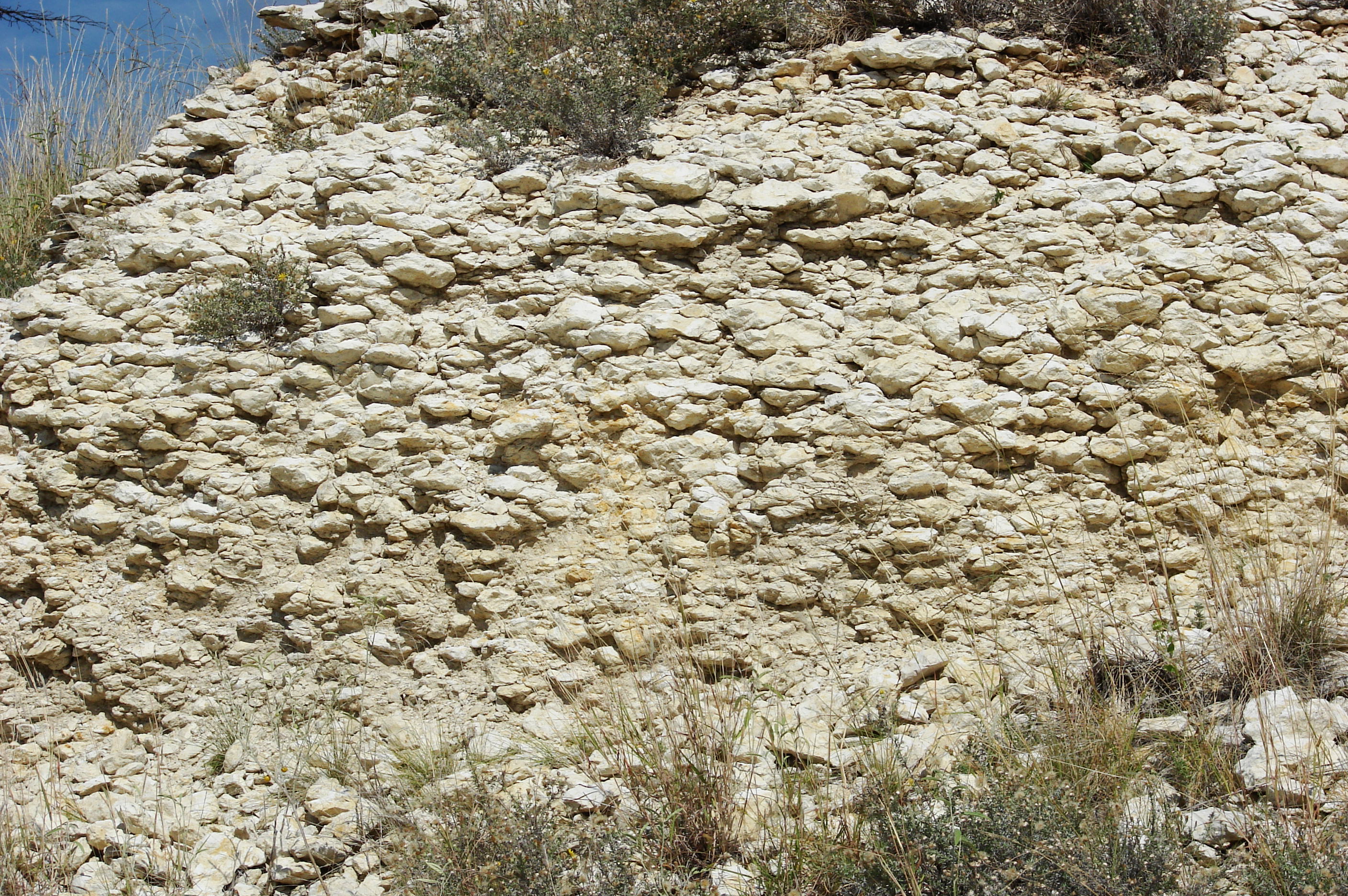
Caliche is a sedimentary rock, a hardened deposit of calcium carbonate. This calcium carbonate cements together other materials, including gravel, sand, clay, and silt. It is found in aridisol and mollisol soil orders. Caliche occurs worldwide, generally in arid or semiarid regions, including in central and western Australia, in the Kalahari Desert, in the High Plains of the western USA, and in the Sonoran Desert. Caliche is also known as hardpan, calcrete, kankar (in India), or duricrust. The term caliche is Spanish and is originally from the Latin calx, meaning lime.
source: http://en.wikipedia.org/wiki/Caliche
Subscribe to:
Posts (Atom)